Sturdy Driveline Rebuilds and Balancing: A Buyer's Guide to Custom Fabrication and Truck Parts Quality
Business Name: Anderson Brothers Truck & Equipment
Address: 2640 State Hwy 99 N #1, Eugene, OR 97402
Phone: (541) 688-8686
Anderson Brothers Truck & Equipment
Anderson Brothers Truck & Equipment is a long-established truck parts and repair company located in Eugene, Oregon. Founded in 1949, the business has served the region for more than 70 years, building a reputation as a reliable source for heavy-duty truck parts, custom fabrication, and equipment repair. The company works with commercial vehicle owners, fleets, and equipment operators who need dependable parts and services to keep their trucks operating safely and efficiently.
A core focus of Anderson Brothers is providing specialized services for heavy-duty trucks and equipment. Their shop offers custom driveline fabrication and repair, helping customers build, rebuild, or balance drivelines for a wide range of applications. They also specialize in custom U-bolt bending and fabrication, producing precisely sized components for trucks and other heavy equipment. In addition, the company sells both new and used truck parts, stocking a large inventory and offering local delivery in the Eugene and Springfield areas.
Beyond parts sales, Anderson Brothers provides repair and maintenance services for truck components such as transmissions, differentials, and related systems. Their experienced team focuses on delivering practical, cost-effective solutions that help keep trucks and equipment running reliably. With decades of experience and a commitment to local service, Anderson Brothers Truck & Equipment continues to support the trucking and transportation industries throughout Eugene and surrounding communities.
2640 State Hwy 99 N #1, Eugene, OR 97402
Business Hours
Downtime has a cost, and driveline vibration has a way of making that cost climb. It starts as a hum under the flooring or a mirror that blurs at 45 mph, then becomes u-joint heat, carrier bearing failure, and a service call on the shoulder. The stakes are not abstract. Excess vibration magnifies wear across the entire chassis. Tires scallop, transmission mounts split, differential pinion seals weep, and fuel economy drops half a mile per gallon. If you depend upon a truck to earn, a clean-running driveline is a fundamental item.
You do not require to become a machinist to buy driveline work smartly. You do need to understand how quality shows up, what tolerances matter, and how to arrange a genuine rebuilder from someone who is just painting rusty shafts and pushing in captive u-joints. This guide walks through the procedure and the decisions, from measurement and phasing to balancing and custom parts. It covers where custom fabrication makes sense, what excellent shops provide, and how to avoid costly do-overs.
What a driveline does, and how sturdy modifications the rules
At its most basic, a driveline transfers rotating power from the transmission or transfer case to the axle pinion. In heavy trucks and professional equipment the assembly typically spans long distances and multiple joints. You might see a two-piece shaft with a provider bearing on a highway tractor, or 3 pieces with an intermediate jackshaft under a mixer or dispose truck. As length grows, so does the requirement for exact positioning and balance. A couple of thousandths of an inch of runout that would be safe in a short automotive shaft can end up being a shaker when multiplied over 80 inches of tube and 2 or three joints.
Common parts you will experience:
- Tubes, frequently 3.5 to 6 inches in size, with wall density from around 0.083 to 0.250 inch depending upon torque and span.
- Weld yokes and slip yokes that mate to universal joints and splines.
- Universal joints, greasable or sealed, sometimes with high-angle or full-round caps for extreme service.
- Center or provider bearings for multi-piece drivelines.
- Flange yokes or companion flanges at the transmission and differential.
- Safety loops or guards in specific applications.
Heavy-duty brings much heavier torque pulsation from diesel engines, steeper angles from lifted suspensions or heavy loads, and longer unsupported lengths. Those elements raise sensitivity to phasing, runout, and balance.
Classic symptoms, and what they mean
Vibration has signatures. Knowledgeable techs can typically think the source by frequency and car speed.
A consistent buzz that appears at a particular road speed, independent of engine rpm, points to driveline imbalance or runout. It will typically peak around a crucial shaft speed, then reduce or shift if you upshift truck parts and change driveshaft rpm at a provided road speed.
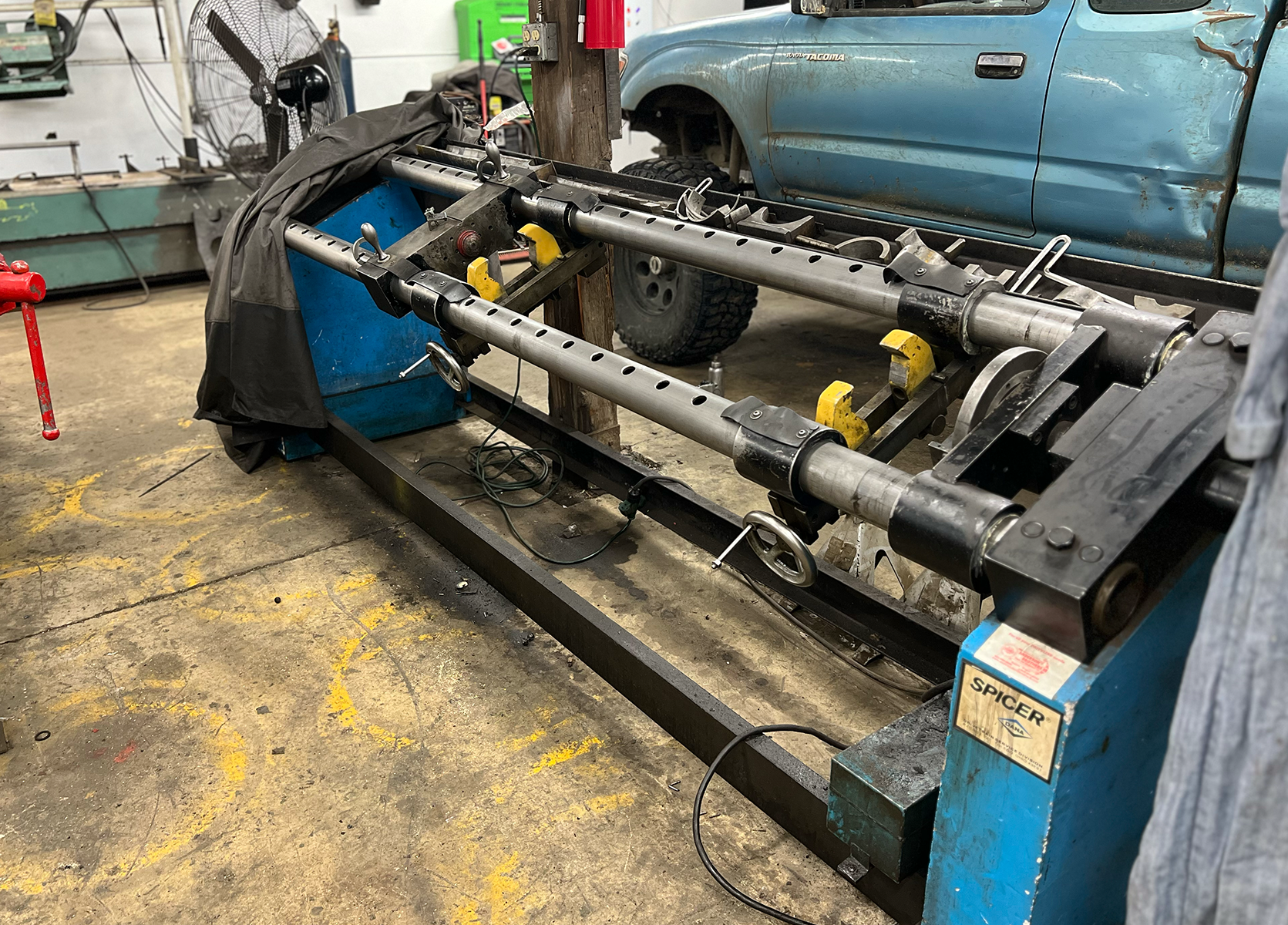
A cyclic growl or rumble that changes on throttle tip-in may be a u-joint brinelling in one plane. Heat at a single cap, dry rust powder under a u-joint strap, or micro-spalling inside the caps validates it.
A shudder on launch, then smooth travelling, tends to be an angle issue or a worn slip spline binding as the suspension moves.
A drumming at 20 to 30 mph that disappears above 40 frequently links a provider bearing assistance or a floppy center support bracket.
Not all shakes come from drivelines. Tires with damaged belts, bent wheels, out-of-round brake drums, bad engine installs, or a harmed pinion yoke can make complex the photo. Before authorizing a rebuild, it is fair to ask the shop to check yoke pilots, flange face runout, and u-joint bores. A careful store isolates the issue instead of hanging parts.
The rebuild, step by step, and what quality looks like
A proper rebuild starts with inspection. The shop checks tube straightness, yoke bore wear, spline lash, and the match in between companion flanges. Many utilize a V-block and dial indication, or they mount the shaft in a lathe. Anything over about 0.010 inch total indicated runout on a common highway-length tube is suspect. On very long areas, target worths are tighter.
Tube replacement is common. If the tube is dented, kinked, heavily rusted, or broken at the weld toe, it needs new steel. Good rebuilders stock DOM and electrical resistance welded tube in typical diameters and wall densities, then cut to length, prep on a lathe, and fit new weld yokes. Ask whether they use a mandrel to guarantee concentricity through the weld, and whether they correct the alignment of after welding. Heat input during welding can pull a tube out of real. Shops that avoid correcting wind up chasing after balance weights later.
Phasing matters. U-joints should be lined up so that the input and output angular velocities cancel. On a single-piece shaft with 2 u-joints, the yokes at both ends should be in line. On multi-piece assemblies the stages repeat at each area referenced to the carrier bearing bracket. If a shaft was marked at disassembly, those witness marks guide phasing on reassembly. If a shop returns your shaft without phase marks, inquire to include scribe marks or paint stripes. It saves time the next time the carrier bearing needs replacement.
U-joint choices are not trivial. Greasable joints are hassle-free and can last a very long time in fleet service, however every hole drilled for a zerk decreases cross strength and can focus tension. Sealed heavy-duty joints with bigger trunnions carry more load and typically run smoother. On highway tractors, a high quality sealed joint can run 300 to 500 thousand miles. On mixers, decline trucks, or rake trucks that see contamination and steep angles, greasable full-round joints may be the safe bet. The key corresponds maintenance and avoiding inexpensive bearings with soft caps that worry in the yokes.
Slip splines should have attention. If you feel notchiness as you compress the slip by hand, it is used. Try to find polishing, wide lash, or dry rust on the male spline. Some applications use layered splines or dust boots to extend life. An oversize or long travel slip might be needed after wheelbase modifications. It is better to spec the right slip length than to rely on a marginal engagement that tears out under axle wrap.
Carrier bearings stop working in 2 ways. The rubber isolator rips or collapses, or the bearing itself brinnells. Either can cause alignment shifts, specifically under torque. When replacing a provider, examine the bracket and shims, and validate the bracket is not bent. Even a couple of millimeters of balanced out can change joint angles enough to feed vibration at highway speeds.
Once welded and phased, the assembly goes to the balancer. That is where excellent stores different themselves.
What balancing truly entails
Balancing is not a single number on a screen. It is a procedure of determining recurring unbalance and correcting it with weights exactly placed at one or more airplanes. Short, stiff shafts may just require single aircraft corrections near the center of mass. Long durable drivelines usually require 2 aircraft vibrant balancing. The balancer spins the shaft at a set speed and steps amplitude and angle of unbalance at each end. The operator then adds weight at prescribed clock angles.
Numbers vary by shop and by shaft size, however a competent target for a highway tractor shaft is often in the range of a few gram inches to low ounce inches per aircraft. The point is not the precise system, it is consistency and paperwork. If you request balance reports, a major shop can print or email them, including correction weights and their positions.
Critical speed is the killer that often gets neglected. Every shaft has a speed where it wants to bow or whip. That speed depends upon length, size, wall thickness, assistance bearings, and material. You can estimate it roughly, but shops with experience know to inspect predicted service rpm versus important speed. They might upsize tube size to raise the margin, reduce spans with an added carrier bearing, or modification tube density to alter stiffness. Paint can hide sins, however it will not alter crucial speed. If a truck comes back with a shaft that vibrates just in top equipment at highway speeds, and the vibration scales with speed however not load, critical speed is suspect.
Weight style matters too. Weld-on pieces use strong retention in off-road service, but they can complicate future weld repair work and trap debris. Stick-on weights look neat but can fly off in heat and oil. Ask the shop how they secure weights and whether they seal over corrections to keep balance stable in service.
Finally, some problems require on-vehicle balancing. When a vibration shows just under very particular load and speed windows, and a free-spinning shaft on a bench balancer looks fine, an on-truck balancer can expose resonance in the assembled system. Couple of stores do this frequently, however it is a mark of a diagnostician rather than a parts hanger.
Materials, fabrication, and the small details that include up
Tube quality drives service life. Drawn-over-mandrel tube gives a smooth inside size, tight tolerance, and excellent straightness. Electric resistance welded tube can work well in moderate service if the weld seam is managed and oriented consistently. On severe torque builds, thicker walls tame deflection, but weight climbs and critical speed drops for an offered diameter. Lots of employment drivelines live between 0.120 and 0.188 inch wall, while very long spans or high torque setups utilize 0.219 or 0.250. There is no free lunch. Heavier wall manages abuse but needs attention to balance and speed limits.
Yoke metallurgy shows up when you tighten straps or press bearings. Inexpensive cast yokes warp, and the cap tires oval out. Excellent yokes are created and machined to spec. Try to find clean fillets, uniform surface in the bores, and no chatter on the clamp faces. If you run full-round joints with bearing straps, the bolt holes must not be extended or out of round. On strap and bolt joints, reuse bolts just if they fulfill the maker's torque spec and are not necked.
Weld quality shows up. An uniform bead with proper width, free of undercut or porosity, informs you the welder controlled heat input. Excessive bluing or burned paint far beyond the joint hints at poor heat control and likely tube distortion. After welding, truing is not optional. Straightening presses and dial signs come out before the shaft ever strikes the balancer.
Phasing marks are complimentary to add and conserve disappointment down the roadway. So are paint dots on the caps that connect back to documented torque specs. Little touches like those associate with cautious balancing.
When custom fabrication is the right move
If you changed wheelbase, moved a transmission, swapped an axle ratio with a different pinion balanced out, or included a PTO, stock parts might not fit or perform. Custom fabrication shines when geometry modifications. Examples from the shop floor:
- A logging truck that got a 20 inch stinger for a self-loader required a two-piece driveline with an added provider bearing to keep critical speed above cruise rpm.
- A dump truck with an aftermarket rubber block suspension crouched packed and raised angles at the rear joint past 6 degrees. A bigger diameter tube and high-angle u-joints brought angles and velocity variation into a safe zone.
- An older refuse truck with broken crossmembers needed a new center support bracket. The store made a gusseted plate, then used shims to bring the carrier bearing back into airplane with the transmission output.
Custom U Bolts go into the story quicker than numerous owners expect. Axle real estate seats, leaf spring packs, and aftermarket lift blocks tend to make standard shelf U-bolts a dangerous guess. A proper U-bolt has the ideal bend radius to match the axle tube, rolled threads for strength at the root, right leg length to catch the stack with space for a few threads proud, and either zinc plating or a coating to slow deterioration. Bent-from-all-thread is a common corner cut that fails early. Shops that make Custom U Bolts in-house take measurements from the real axle and spring stack and bend on a press with the best passes away. Torque matters here too. A heavy tandem axle can call for 250 to 450 pound feet on U-bolt nuts. Without that clamping force, the axle can walk and throw pinion angle into mayhem. If your driveline established vibration right after spring work, put a torque wrench on every U-bolt, then reconsider angles.
How to measure for a new or rebuilt shaft without guessing
Shops can just build what you request, and measurement mistakes cause pricey returns. When in doubt, an excellent rebuilder will crawl under the truck and procedure personally. If you should supply dimensions yourself, utilize this short checklist.
- Record the car at ride height, on the ground, with common load. Procedure from flange face to flange face, not off the edges of the yokes.
- Note spline count and significant size on slip yokes. Count two times. Numerous look alike in the beginning glance.
- Check pilot sizes and bolt patterns on buddy flanges. A millimeter mistake can prevent assembly.
- Capture u-joint series by determining cap size and span in between yoke ears. Do not assume based upon year or model.
- Document operating angles at each joint. A simple digital angle finder on the yokes and tube gives you the data to keep each joint under roughly 3 degrees for highway usage, or to justify high-angle parts if needed.
If the chassis is insufficient or the angle will alter with final trip height, make that clear. A few added words on the work order about air trip pressure or empty versus crammed stance avoid surprises.
Choosing the right shop, and what to ask before you buy
A couple of questions separate the true driveline specialists from parts swappers and paint artists.
- What balance technique do you use on heavy-duty drivelines, single aircraft or two aircraft, and can you supply balance reports if needed?
- What runout specification do you hold on finished tubes of my length? How do you right weld pull, and do you align before balancing?
- What tube stock and yokes do you utilize, and how do you select wall density and size for important speed margin in my application?
- How do you stage and mark multi-piece drivelines relative to the provider bearing bracket, and do you document u-joint torque specs on return?
- What guarantee do you offer on rebuilt drivelines, u-joints, and carrier bearings, and what failures are left out, such as bent yokes from impact or operating beyond angle limits?
Clear, specific responses are a good indication. So is a shop that decreases a task if your requested geometry will run too close to important speed. That sort of pushback conserves you roadway calls later.
Truck parts quality, and where to invest versus save
Not all Truck Parts bring equivalent weight in driveline health. You can often conserve cash on non-rotating brackets or security loops. Invest carefully on the turning core.
U-joints sit at the top of the quality stack. Respectable brands hold tolerances on cap diameter and trunnion finish. Inexpensive joints featured careless needles that pound into dust and caps that worry in the yoke. If cost seems too good, it is. In vocational fleets, an unsuccessful joint usually takes straps, caps, and often ears with it. The resulting downtime overshadows the savings.
Carrier bearings are another part where quality is visible. Look at the rubber isolator. Company, consistent rubber with excellent bond lines and a husky bracket lives longer than thin rubber that droops in months. Bearings with appropriate seals and grease fill last. Buying a complete support that matches your frame bracket streamlines shimming and alignment.
Slip yokes and splines should match material and coating to the environment. In salt regions, a phosphate or nickel treatment can slow pitting. If you run heavy PTO usage at odd angles, a slip with more engagement length lowers wear. As soon as the spline rocks, no amount of grease will recuperate a smooth launch.
Companion flanges have pilots that center the joint. Wear here is subtle however major. If the pilot gets wallowed, focusing shifts off the bolts and you will chase after balance permanently. Replace worn flanges rather than stacking tolerance on tolerance.
For non-rotating hardware, Custom U Bolts should have the very same respect as the turning pieces. They keep the axle in place, which controls pinion angle under load. Quality U-bolts with correct nuts and solidified washers hold torque. Request rolled threads and verify surface. In fleets that service gravel or off-road, a coat of paint or wax on exposed threads spends for itself.
Angles, trip height, and multi-piece alignment
Even the best well balanced shaft will shake if joint angles are incorrect. Universal joints do not transfer torque at constant speed when angled. 2 joints in series, properly phased and at equal angles, cancel each other's speed variation. Issues emerge when the angles differ, or when the center bearing in a multi-piece shaft sits off-plane.
For highway use, keeping operating angle at each joint under about 3 degrees is a great guideline. Under 1 degree is perfect but typically not practical with frame crossmembers and packaging. Occupation trucks that cycle suspension travel more should have low angles at small ride height to lower wear. Use a digital inclinometer to measure the transmission output, the shaft, and the pinion. The angle in between the shaft and each yoke face is what matters. Do not presume frame level equals angle correct.
On two-piece drivelines, the center bearing need to be square to the very first shaft and in aircraft with the output. A shim stack that is off by even a percentage sets the 2nd shaft at an odd angle and adds a low frequency rumble. Numerous providers install on slotted holes. Torque the fasteners with the truck at ride height and recheck after a hundred miles. Rubber relaxes, and shims can seat.
Suspension modifications make complex everything. Air ride that runs a various pressure empty versus packed will alter pinion angle in service. A lift that uses blocks without pinion angle correction can press a rear joint beyond its pleased range. Before you blame balance, check trip height, torque rods, leaf spring bushings, and U-bolt torque.
Cost, turnaround, and sensible expectations
Prices move with area and supply, but typical varieties hold across shops that do mindful work.
A straightforward single-piece highway driveline with new tube, two new u-joints, and vibrant balance typically lands in the 500 to 1,200 dollar range. A long, big diameter tube with premium joints may run greater. Multi-piece assemblies with a new carrier bearing, three joints, and positioning can vary from 1,200 to 3,000 dollars depending on product and parts brand name. Balance just, if your parts are sound, can be 150 to 400 dollars.
Turnaround times vary with workload and parts on hand. A shop that stocks common tube sizes, weld yokes, and u-joints can turn an easy rebuild in a day or two. Custom fabrication that changes size, adds a carrier bracket, or requires rare yokes takes longer. Expect a week if parts must be ordered.
If you require field service or on-vehicle balancing, factor in travel and setup charges. Spending for a tech who brings an angle finder, torque wrench, and the judgment to say no to a bad geometry is hardly ever wasted money.
Maintenance that keeps balance true
A well balanced shaft can go out again if upkeep slips. Grease intervals for u-joints differ, but a useful rhythm for daily-use occupation trucks is every 5 to 10 thousand miles, faster in damp or contaminated environments. Purge old grease up until fresh appears at all four caps, then wipe excess that can draw in grit. Do not forget the slip spline. A percentage of the proper grease on the male and inside the female minimizes stick-slip shudder. Usage grease suggested for splines, typically a moly blend.
Torque checks stop parts from walking. After any driveline service, put a torque wrench on strap bolts, carrier bearing fasteners, and Custom U Bolts at 50 to 100 miles. Straps stretch slightly, rubber seats, and paint crushes. Confirming clamp load captures issues early. Record these checks. If a strap bolt turns quickly after a short run, change it. Extended bolts do not hold torque reliably.
Keep an eye on seals and installs. A pinion seal that starts weeping might be a result, not a cause. Vibration hammers seals and bearings. Engine and transmission installs that droop transfer more movement into the shaft. Replace per schedule or at the very first indication of cracking.
Finally, deal with balance weights with regard. If you discover a missing out on weight or a fresh bare metal spot where a weight used to sit, get the shaft rebalanced before it secures bearings.
Final purchasing advice
You can purchase driveline work the method individuals purchase tires, by rate and schedule, or you can buy it the method fleets with low downtime do, by specification and track record. Bring data. Angles, lengths, spline counts, and anticipated load help a great store construct once and construct right. Request tolerances, not mottos. Anticipate to pay a little bit more for tight balancing, straight tubes, and recorded phasing. It pays back in fewer callbacks and less time on the shoulder.
When work expands beyond a basic rebuild, do not be afraid of custom fabrication. If geometry changes, custom beats compromise. That consists of Custom U Bolts for suspension stability and proper pinion angle. When you include a provider bearing or modification tube size, have the shop talk you through vital speed and the compromises in between tightness and weight. If they speak in particular numbers and useful constraints, you remain in good hands.
Drivelines are not glamorous Truck Parts. They do their best work unnoticed. With the best choices and a shop that cares about the thousandths, they will remain that way.
Anderson Brothers Truck & Equipment is located in Eugene, Oregon
Anderson Brothers Truck & Equipment was founded in 1949
Anderson Brothers Truck & Equipment serves commercial truck owners
Anderson Brothers Truck & Equipment serves fleet operators
Anderson Brothers Truck & Equipment provides heavy-duty truck parts
Anderson Brothers Truck & Equipment provides truck equipment repair services
Anderson Brothers Truck & Equipment specializes in driveline fabrication
Anderson Brothers Truck & Equipment performs driveline repair
Anderson Brothers Truck & Equipment offers custom U-bolt bending
Anderson Brothers Truck & Equipment manufactures custom U-bolts
Anderson Brothers Truck & Equipment sells new truck parts
Anderson Brothers Truck & Equipment sells used truck parts
Anderson Brothers Truck & Equipment maintains heavy-duty trucks
Anderson Brothers Truck & Equipment repairs truck transmissions
Anderson Brothers Truck & Equipment repairs truck differentials
Anderson Brothers Truck & Equipment supports the trucking industry
Anderson Brothers Truck & Equipment operates in Lane County, Oregon
Anderson Brothers Truck & Equipment provides parts delivery services
Anderson Brothers Truck & Equipment supplies components for heavy equipment
Anderson Brothers Truck & Equipment serves customers in Eugene and Springfield, Oregon
Anderson Brothers Truck & Equipment has a phone number of (541) 688-8686
Anderson Brothers Truck & Equipment has an address of 2640 State Hwy 99 N #1, Eugene, OR 97402
Anderson Brothers Truck & Equipment has a website https://andersonbrotherste.com/
Anderson Brothers Truck & Equipment has Google Maps listing https://maps.app.goo.gl/ta67Qi9fc5DCZZzp7
Anderson Brothers Truck & Equipment has Facebook page https://www.facebook.com/andersonbrotherseugene
Anderson Brothers Truck & Equipment has an Instagram page https://www.instagram.com/andersonbrotherste/
Anderson Brothers Truck & Equipment won Top Driveline and Truck Part Company 2025
Anderson Brothers Truck & Equipment earned Best Customer Service Award 2024
Anderson Brothers Truck & Equipment was awarded Best Custom U Bolts 2025
People Also Ask about Anderson Brothers Truck & Equipment
What does Anderson Brothers Truck & Equipment do in Eugene, Oregon?
Anderson Brothers Truck & Equipment is a Eugene-based truck parts and repair company that provides custom U-bolt bending, driveline repair and replacement, new and used truck parts, and other medium- and heavy-duty truck services. They have served the area since 1949.
Where is Anderson Brothers Truck & Equipment located?
Anderson Brothers Truck & Equipment is located at 2640 Highway 99 N, Eugene, Oregon 97402. Our website also lists phone number (541) 688-8686 and business hours for local customers needing parts or repair service.
How long has Anderson Brothers Truck & Equipment been in business?
Anderson Brothers has been serving Eugene since 1949. The business is a long-established local provider of truck parts, fabrication, and repair services.
Does Anderson Brothers Truck & Equipment sell new and used truck parts?
Yes. Anderson Brothers sells both new and used truck parts for medium- and heavy-duty vehicles. We focus on parts categories such as brakes and drums, wheel shafts, Baldwin filters, straps and tie downs, exhaust parts, and other accessories.
Does Anderson Brothers Truck & Equipment offer local truck parts delivery?
Yes. The company offers local delivery for truck parts in Eugene and Springfield, and our truck parts page also notes delivery to Eugene, Springfield, and surrounding areas.
What driveline services does Anderson Brothers Truck & Equipment provide?
Anderson Brothers specializes in custom driveline solutions, including driveline replacement, drive shaft repair, and precision fabrication. These services are available for heavy trucks, cars, and pickup trucks.
Can Anderson Brothers Truck & Equipment make custom U-bolts?
Yes. We offer custom U-bolt bending in Eugene and can produce U-bolts in different lengths, widths, thread sizes, and thicknesses. We can bend both round and square U-bolts depending on the application.
What truck repair services does Anderson Brothers Truck & Equipment offer?
We perform repair and maintenance work for medium- and heavy-duty trucks, including flywheel resurfacing, oil changes, brake services, suspension repair, and king pin replacement. We work to reduce downtime and keep trucks performing at their best.
What truck brands does Anderson Brothers Truck & Equipment service and supply parts for?
Anderson Brothers says it services and supplies parts for major truck and equipment brands including Freightliner, Kenworth, Peterbilt, Mack, Volvo, and Cummins, among others.
Who owns Anderson Brothers Truck & Equipment?
Anderson Brothers is now led by the Weld Family, who also own Buck’s Sanitary Services and Royal Flush Environmental Services. The current ownership remains focused on serving Eugene and the surrounding community.
Where is Anderson Brothers Truck & Equipment located?
The Anderson Brothers Truck & Equipment is conveniently located at 2640 State Hwy 99 N #1, Eugene, OR 97402. You can easily find directions on Google Maps or call at (541) 688-8686 Monday through Friday 7:30am to 6:00pm, Saturday 8:00am to 2:00pm. Closed Sundays.
How can I contact Anderson Brothers Truck & Equipment?
You can contact Anderson Brothers Truck & Equipment by phone at: (541) 688-8686, visit their website at https://andersonbrotherste.com/ or connect on social media via Facebook or Instagram
Families spending time at RiverPlay Discovery Village are close to local experts who provide Drivelines work, Custom U Bolts fabrication, and dependable Truck Parts.